



The Complete Guide to Men's Shirt, Blazer, Coat & Kurta Buttons (Metal vs Wooden vs ABS)
Overview: Why Buttons Matter More Than You Think
At first glance, a button seems like the smallest, most forgettable part of an outfit — until it's missing, mismatched, or the wrong finish for the fabric it's sewn onto. In reality, buttons are one of the most defining details of tailored menswear. They hold a shirt, blazer, or sherwani together, yes, but they also communicate craftsmanship, formality, and personal style long before anyone reads a label.
Whether you're a tailor sourcing button clothes in bulk, a boutique owner comparing metal shirt buttons against plastic alternatives, or a groom picking out sherwani buttons for a wedding outfit, understanding the different types of buttons — their materials, sizes, and best use-cases — makes it far easier to get the finished garment right the first time. In this guide, we break down everything from basic button types and sizing to a detailed comparison of metal, wooden, and ABS buttons, so you can shop with confidence whether you're looking for a single fancy shirt button or placing a wholesale order for menswear buttons.
Buttons are also one of the easiest ways to personalize an otherwise standard garment. A change in material or finish — swapping a plain plastic button for a brass button, for instance — can shift a shirt from "everyday basic" to "considered detail" without changing the fabric or cut at all. That's part of why sewing buttons and button replacement remain such a common request for tailors, and why so many boutiques stock multiple button materials — from basic sew-throughs to more decorative designer buttons — rather than a single standard option.
A Quick History of the Button in Menswear
Buttons have been part of fastening garments for centuries, evolving from purely functional closures into decorative statements. Historically, buttons were markers of status — the more ornate the finish, the more affluent the wearer was assumed to be. That tradition carries through today in formal Indian menswear, where a well-chosen sherwani button or gauntlet button can visually elevate an entire wedding outfit, while a simple shirt button for men is expected to disappear quietly into the garment and do its job without drawing attention.
Modern manufacturing has expanded button materials far beyond horn, bone, and shell, giving designers, tailors, and everyday shoppers more options than ever — from classic brass button finishes to lightweight, budget-friendly ABS alternatives. Understanding this evolution helps explain why there's no single "best" button material — the right choice depends entirely on the garment, the occasion, and how the piece will be worn and cared for.
Types of Buttons by Material: Metal vs Wooden vs ABS Buttons
Choosing the right button material affects durability, appearance, weight, and cost — and different garments call for different materials. Below is a closer look at the three most common categories, followed by a side-by-side comparison.
Metal Buttons
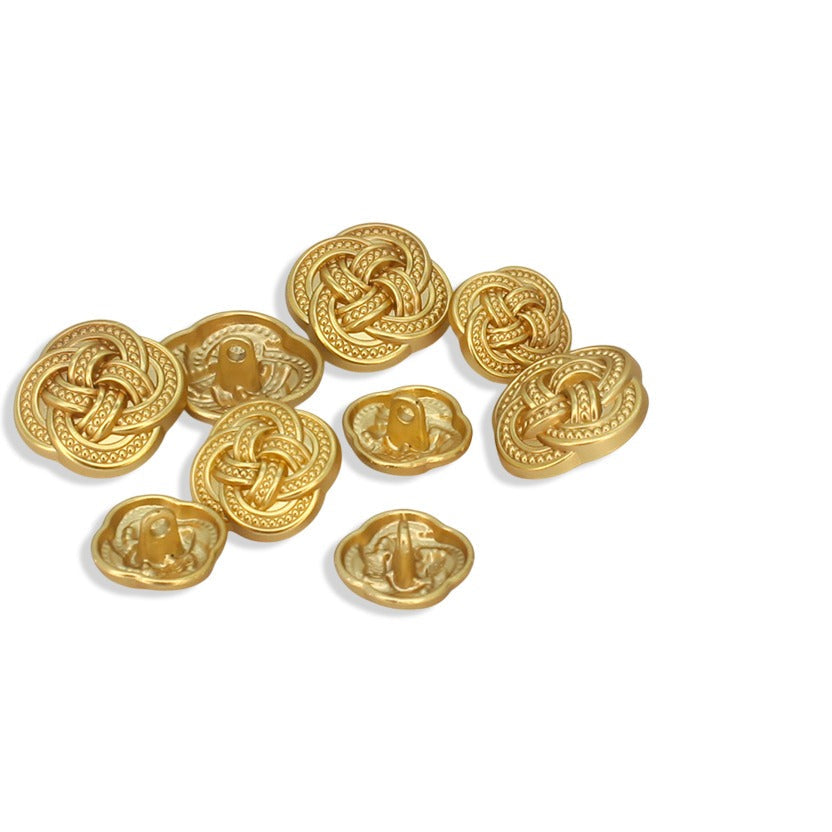
Metal buttons — including brass button and coated alloy finishes — are the most popular choice for structured formalwear like coats, blazers, and sherwanis. They're heavier than plastic alternatives, hold their shine through repeated washing, and are far less likely to crack or fade over time compared to lighter materials. A flat brass buttons finish, for example, gives a clean, classic look that suits both business formals and festive Indian wear, while a black velvet button — a fabric-wrapped metal base — offers a richer, more muted finish for eveningwear and sherwanis.
Metal is generally the best pick when durability and a premium look matter more than weight — think coat buttons black, blazer button for men designs, and sherwani buttons meant for repeated wear across multiple seasons and dry-cleaning cycles.
Wooden Buttons
Wooden buttons bring a natural, textured look that's popular in casual and semi-formal menswear, as well as sustainable or eco-friendly fashion lines. Unlike metal, wood is lightweight and warm to the touch, and it pairs particularly well with linen, cotton, and khadi fabrics. The trade-off is durability — wooden buttons are more prone to chipping or cracking under heavy machine washing compared to metal or ABS, so they're better suited to garments that are hand-washed or dry-cleaned rather than run through daily laundry.
If you're building a rustic, earthy, or sustainability-focused menswear line, wooden buttons are worth considering over standard metal shirt buttons — though for daily formal wear, most tailors still lean toward metal or ABS purely for longevity and low maintenance. Note that wooden buttons are typically a smaller, specialty line compared to metal and ABS ranges, so availability across sizes and finishes tends to be more limited — it's worth checking current stock before planning a large order around wood specifically.
ABS (Plastic) Buttons
ABS buttons are a durable, cost-effective plastic option widely used for everyday button clothes — shirts, trousers, and casual jackets. They're lightweight, highly resistant to cracking, available in almost any colour buttons finish you can imagine, and significantly cheaper to produce in bulk than metal or wood. This makes ABS the standard choice for high-volume tailoring and mass-market menswear, including basic shirt buttons black and full stylish button shirts ranges, where cost efficiency matters just as much as appearance.
The main limitation is perceived value — ABS buttons don't carry the same premium feel as a metal button shirt or brass finish, so for wedding wear, sherwanis, or premium blazers, metal or fabric-covered options are usually preferred. For day-to-day shirting and trousers, however, ABS often outperforms both wood and metal on pure cost-to-durability ratio.
Quick Comparison: Metal vs Wooden vs ABS Buttons
| Factor | Metal Buttons | Wooden Buttons | ABS (Plastic) Buttons |
|---|---|---|---|
| Durability | High — resists cracking, holds shine over time | Medium — can chip with heavy machine washing | High — resists cracking, very low maintenance |
| Weight | Heavier, more premium feel | Light, warm, natural feel | Lightest of the three options |
| Best suited for | Blazers, coats, sherwanis, formalwear | Casual wear, linen/cotton, sustainable fashion | Shirts, trousers, everyday menswear |
| Typical cost | Mid to high | Mid-range | Low, ideal for bulk button clothes orders |
| Finish options | Brass, matte, glossy, fabric-covered | Natural wood tones | Wide range of colour buttons and glossy finishes |
Other Popular Button Materials
Beyond metal, wood, and ABS, many menswear ranges also include horn-style and coconut shell buttons for a textured, natural look on jackets and coats, resin or shell-effect buttons for a more contemporary finish, and single hole buttons used for specific garment and craft applications where a traditional two- or four-hole shank isn't practical. It's worth noting that decorative buttons like these also show up outside fashion entirely — upholstery and furniture finishing, for instance, use similar tufted button styles, though those are engineered for a very different kind of durability than a garment button needs to withstand.
Buttons for Every Garment: A Detailed Breakdown
Material is only half the equation — the other half is matching the button to the garment it's going on. Here's how the most common categories break down.
Shirt Buttons
For everyday and formal shirts, the shirt button for men typically ranges from 10mm(16L) for collar and cuff buttons up to 13mm(20L)–15mm(24L) for the front placket — these are the most commonly stocked shirt button sizes across our range. Metal shirt buttons offer a premium finish for formal shirting, while black shirt buttons and shirt buttons black or classic white options suit more versatile, everyday designs. For statement shirting, a fancy shirt button or fancy button shirt style adds detailing without overwhelming the garment, and a metal button shirt in a subtle finish works well for business formals. Across the board, every stylish button — including full stylish button shirts ranges — is built to sit flush against the fabric and withstand regular wear and washing, with standard two- or four-hole sewing patterns for a secure hold.
Jacket & Blazer Buttons
Structured outerwear needs sturdier hardware, which is where buttons jacket for men and blazer button for men collections come in. Our most popular blazer and suit button sizes run from 18mm(28L) up to 21mm(34L), with heavier structured blazers often pairing 18mm(28L) buttons on the front with a slightly larger 20mm–21mm option for cuffs or statement closures. These are typically made from metal or reinforced ABS to withstand the thicker fabric and stitching tension of blazers and jackets, and they're often finished with a subtle sheen to complement structured tailoring rather than compete with it. Blazer buttons also tend to be sewn with a shank back rather than a flat sew-through design, which helps the button sit slightly away from the fabric for a cleaner drape.
Coat Buttons
Coats call for buttons that can handle heavier fabric and colder-weather wear over long periods, which is why coat button sizes tend to run larger than shirt or even blazer buttons — commonly 20mm(32L) up to 23mm(36L), with oversized 25mm(40L) options for heavier overcoats and trench coats. Our black buttons for coat and black coat buttons ranges are designed for both formal overcoats and wedding sherwanis, available in matte and glossy finishes. If you're sourcing a black button for coat for a bulk tailoring order, or comparing coat buttons black across different sizes, metal remains the most reliable material for maintaining shape and finish through repeated use across seasons.
Kurta & Sherwani Buttons
Traditional Indian menswear relies heavily on decorative detailing, and sherwani buttons are among the most searched categories in this space. Decorative sherwani, Jodhpuri, and Bandhgala buttons are most commonly stocked in 18mm(28L) and 23mm(36L) — the two sizes that carry enough surface area for detailed motifs like florals, crests, or royal emblems, while still sitting comfortably on the garment. Our fancy buttons for men's kurta and fancy buttons for kurta ranges combine ornate design with everyday wearability, while boutiques sourcing fancy buttons for mens kurta in bulk, or shoppers looking for a single fancy button for kurta to complete a wedding outfit, will find options across brass, crystal-accented, and fabric-wrapped finishes designed specifically for festive and ceremonial wear.
Trouser & Dress Buttons
Trouser buttons need to be compact, secure, and resistant to friction from repeated wear and movement, which is why most are made from reinforced metal or ABS rather than wood, and why they're typically stocked in the smaller 12mm(19L)–15mm(24L) range — large enough to hold under waistband tension but small enough to sit flat under a belt. Our dress buttons and dress button ranges follow the same principle, offering finer detailing suited to formal and occasion wear without compromising on hold — an important consideration for waistband buttons in particular, which take more mechanical stress than any other button on a garment.
Menswear & Everyday Buttons
For general tailoring and repair needs, our buttons menswear and menswear buttons ranges cover a wide spread of sizes and finishes. Whether you're shopping for men buttons, mens buttons, or men's buttons in bulk for a production run, or simply need button clothes replacements for everyday repairs, consistency across batches matters just as much as design — something mass manufacturers using ABS or standardized metal casting handle particularly well, since colour and size variation between batches can be a real problem for tailors matching an existing garment.
Style, Finish & Statement Buttons
Beyond material and garment type, finish plays a big role in how a button reads visually. A maroon buttons or colour buttons finish can add a pop of personality to an otherwise plain garment, while single hole buttons are often chosen for craft or specific stitching techniques rather than standard four-hole sewing. For statement pieces, buttons with chain and chain buttons designs add movement and detail — popular choices for sherwanis and bandhgalas — alongside the gauntlet button, a decorative cuff-button style traditionally used on formal Indian sleeve closures.
These finish-driven choices tend to matter most in wedding and festive dressing, where the goal isn't just function but visual impact — a single well-placed statement button can do more for an outfit's overall look than an entirely new accessory.
Understanding Button Sizes: mm and Ligne (L)
Button sizes are usually listed two ways — in millimetres (mm) and in Ligne (L), an older European sizing unit still used across the garment trade. As a rough rule, 1 Ligne is about 0.635mm, so a button's Ligne number is roughly its millimetre size multiplied by 1.6 — for example, a 10mm button is listed as 16L, and a 23mm button as 36L.
Here's how sizing typically maps to garment type based on standard stock availability:
| Garment | Common Size Range | Typical Use |
|---|---|---|
| Shirts | 10mm(16L) – 15mm(24L) | Collar, cuff, and front placket buttons |
| Trousers & Dress Pants | 12mm(19L) – 15mm(24L) | Waistband and closure buttons |
| Blazers & Suits | 18mm(28L) – 21mm(34L) | Front closure and cuff detailing |
| Coats & Overcoats | 20mm(32L) – 25mm(40L) | Heavier fabric, front closures |
| Sherwani, Jodhpuri & Bandhgala | 18mm(28L) & 23mm(36L) | Decorative, statement detailing |
| Oversized/Statement Buttons | 25mm(40L) and above | Bold coats, capes, statement outerwear |
If you're not sure which size fits your garment, the safest method is to measure an existing button on the item (diameter, not including the shank) and match it to the closest mm size above, rather than guessing from Ligne alone.
How to Choose the Right Buttons: A Buying Guide
When comparing options, it helps to work through the decision in order — garment first, then material, then finish:
- Match the fabric weight. Heavier fabrics like coats and blazers need metal or reinforced ABS; lighter fabrics like linen shirts can carry wooden or standard plastic buttons comfortably without added bulk.
- Check the size chart. Button sizes typically range from 10mm(16L) for shirt collars up to 25mm(40L) and above for coats and outerwear — see the sizing table above, and always confirm against your garment's existing buttonholes before ordering in bulk.
- Consider hole count and shank type. Most shirt and trouser buttons use a standard two- or four-hole design, while decorative sherwani and gauntlet buttons often use a shank-style back for a cleaner front finish.
- Compare button price across materials. ABS is the most cost-efficient option for bulk button clothes orders, metal sits in the mid-to-premium range, and decorative sherwani or crystal-accented buttons cost more due to detailing and hand-finishing.
- Browse a full button gallery before ordering. Comparing finishes side-by-side — rather than relying on a single product photo — makes it much easier to match a button to an existing garment or design brief.
If you don't have a specialty supplier for buttons near me locally, sourcing online gives access to a far wider range of sizes, materials, and finishes than most local stores carry, with the same quality delivered directly to your door — useful for single-piece orders, custom buttons for specific designs, and larger wholesale button requirements alike.
Frequently Asked Questions
Q. What's the difference between metal, wooden, and ABS buttons? A. Metal buttons are the most durable and premium-looking, ideal for blazers, coats, and sherwanis. Wooden buttons offer a natural, lightweight look suited to casual and sustainable fashion but are less resistant to heavy washing. ABS (plastic) buttons are the most affordable and durable for everyday use, making them the standard choice for shirts and trousers.
Q. What size buttons are used for men's shirts? A. Men's shirt buttons are typically 10mm(16L)–12mm(19L) for the collar and cuffs, and 13mm(20L)–15mm(24L) for the front placket, with standard sizing available from 10mm(16L) up to 25mm(40L) across our full button range to suit different garment types.
Q. What are sherwani buttons made of? A. Sherwani and kurta buttons are commonly made from brass, metal alloy, or decorative fabric-wrapped bases, often featuring fancy detailing to match festive and wedding outfits.
Q. Are metal buttons better than plastic for everyday wear? A. It depends on the use case. Metal buttons offer a more premium look and hold up well to repeated formal wear, but ABS buttons are more budget-friendly, equally durable for everyday washing, and available in a wider range of colours — making them ideal for high-volume, everyday garments.
Q. What is a gauntlet button used for? A. A gauntlet button is a decorative button, often used on the sleeve cuff of sherwanis and bandhgalas, adding a traditional finishing detail to formal Indian wear.
Q. Can I buy buttons in bulk for tailoring or boutique use? A. Yes — buttons across metal, wooden, and ABS materials are available in bulk quantities across sizes and finishes, suitable for tailors, boutiques, and garment manufacturers sourcing menswear buttons at scale.
Q. Do wooden or ABS buttons work for wedding outfits? A. Generally, metal or fabric-wrapped buttons are preferred for wedding sherwanis and formal blazers because of their premium finish, while wooden and ABS buttons are better suited to casual and everyday garments where cost and low maintenance matter more than visual richness.
Conclusion
Buttons might be small, but the right choice — in material, size, and finish — can make or break the finished look of a garment. Metal buttons bring durability and a premium edge to blazers, coats, and sherwanis; wooden buttons suit casual, sustainability-focused fashion; and ABS buttons offer the best balance of cost and durability for everyday shirts and trousers. Whether you're outfitting a single wedding sherwani or placing a wholesale order for a tailoring business, understanding these differences makes it far easier to choose buttons that actually last — and look right — on the finished garment, no matter which category you're shopping for.